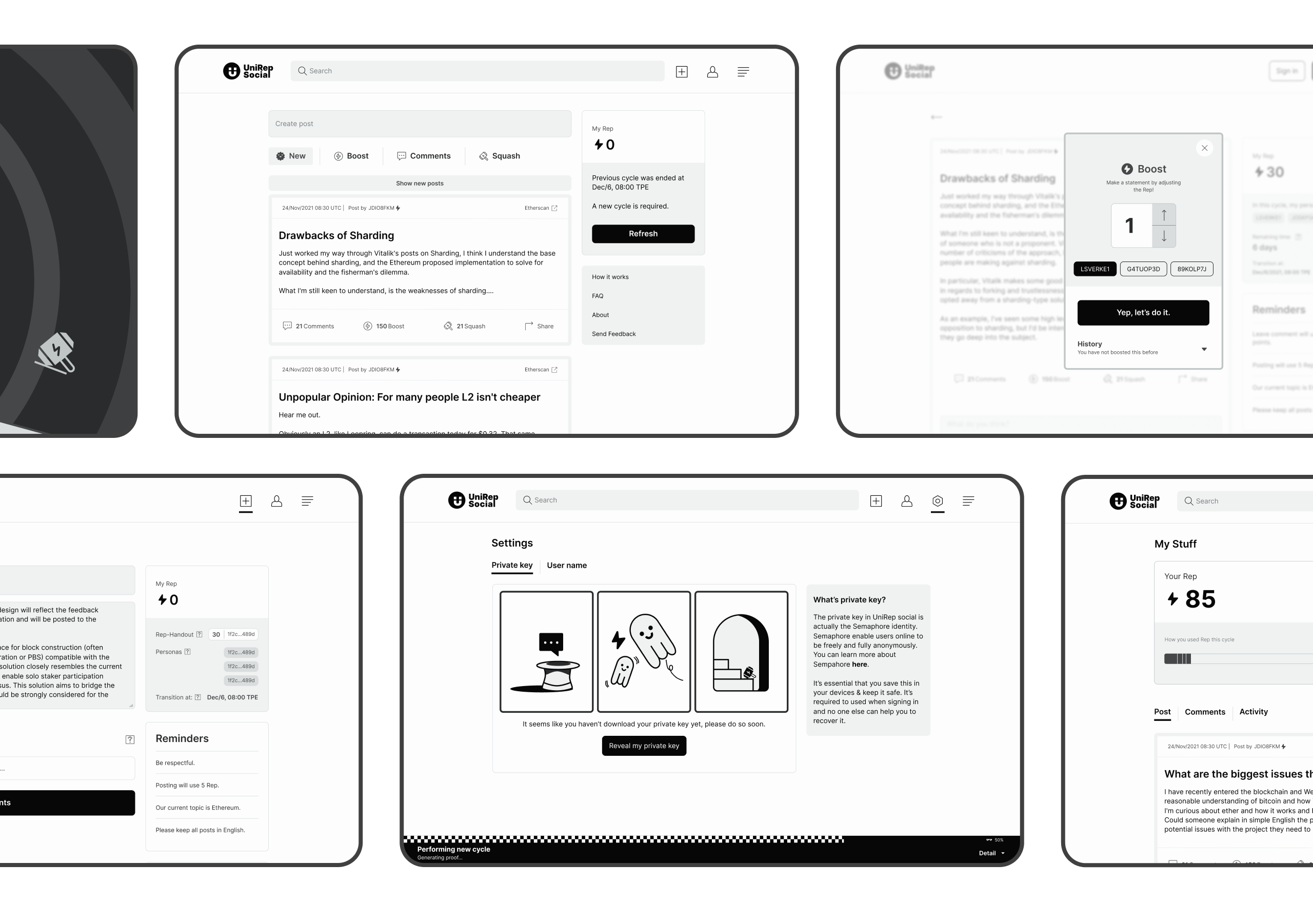
UniRep Social is a community app built on UniRep, a zero-knowledge reputation protocol on Ethereum, and one of the first social products to bring ZKP technology into everyday interaction. Users can post, comment, and vote without a persistent identity, earning and spending reputation through short-lived personas while remaining fully anonymous.
UX & interaction design
End-to-end product design
Product concept & strategy
Web app
Brand & visual identity
Anonymous reputation
In most social platforms, identity is the anchor for trust. In anonymous contexts, trust becomes more nuanced: it can be situational, community-dependent, and elastic, meaning people will “push and pull” on anonymity depending on what the system allows.
This project treated anonymity not as an absence of accountability, but as a different kind of accountability: 1. Reputation exists, but it is not a permanent label. 2. Credibility is earned through contribution, yet is designed to resist long-term tracking.
During the design sprint, we avoided framing anonymity as a binary, “anonymous vs not anonymous”. Instead, map it as a continuum and design UI that supports flexibility and context.
The neutral visual tone
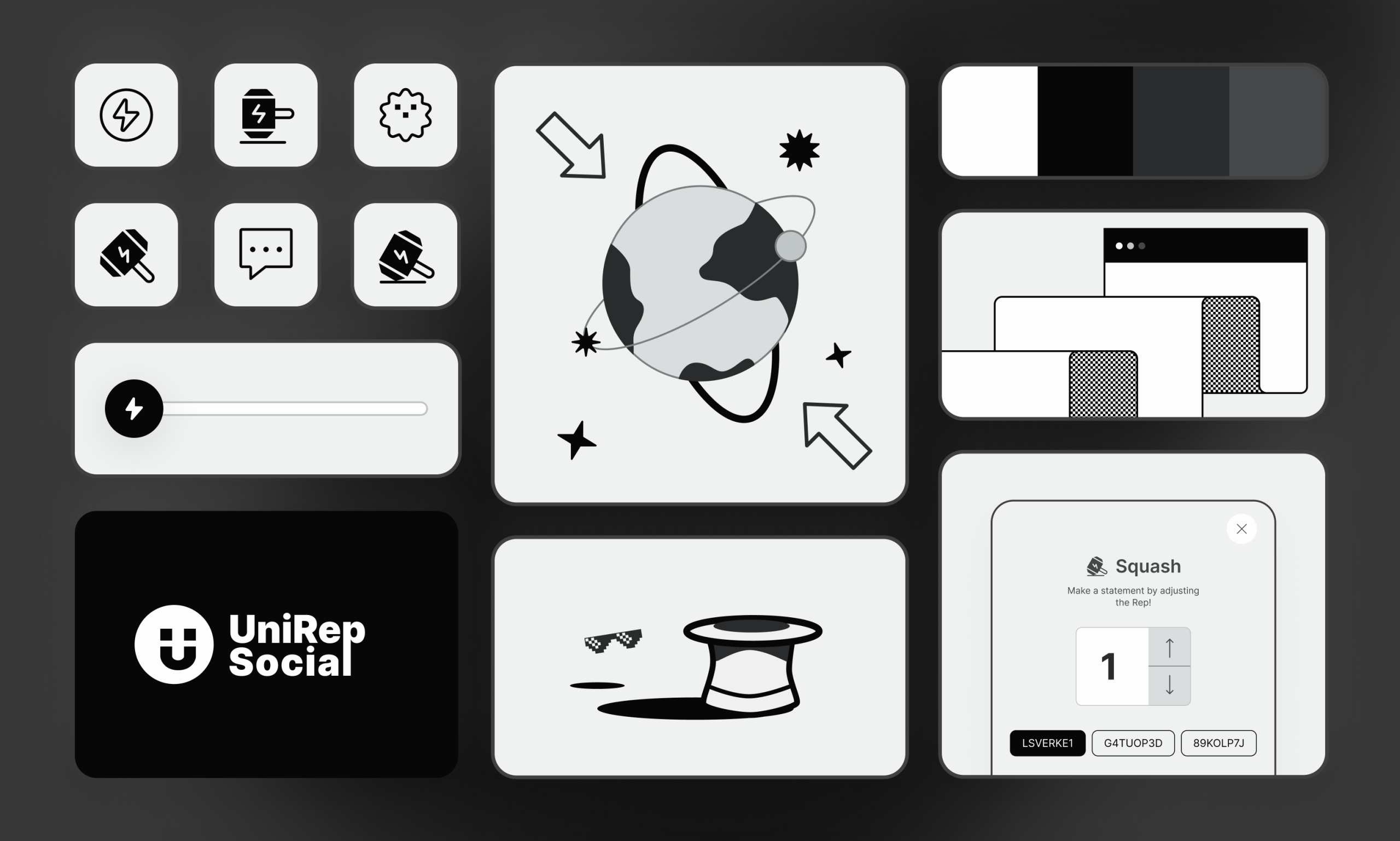
We chose a neutral, low-emotion interface direction to reduce social priming: minimal color signalling, less rage fuel, calm typography and restrained hierarchy, and playful but light illustration to keep the product approachable without turning it into a “meme machine.”
This decision was tied to the project’s premise: if the community is “based on ideas, not identities,” the interface should avoid nudging users toward emotional escalation, tribal cues, or status theatrics.
Onboarding
Abstracting ZK confusion without confusing
ZK apps introduce unfamiliar steps such as proof generation, relays, and syncing state. Even when the system is correct, users can perceive it as slow, “broken”, overly complicated, and risky.
We designed the onboarding to be as smooth as possible by letting users sign up with social media accounts, a familiar pattern that reduces initial friction. In the background, the system generates a zero-knowledge commitment that users need to download and store safely for account recovery. However, we intentionally deferred this step to avoid overwhelming new users during their first experience. The goal was to get users into the app quickly, then introduce the security requirements progressively once they understood the value of what they were protecting.
Interactions, persona per epoch
UniRep applications use epoch keys: temporary public identifiers that function as short-lived personas. Users can have multiple epoch keys per epoch (via nonce), and these keys rotate as epochs change, which we set to a 7-day duration. These epoch keys are public identifiers, but they don’t expose the underlying user identity.
Attestations are applied to epoch keys, and users later “combine” changes during user state transition in zero-knowledge. Epochs themselves are time-based cycles determined by the attester’s epoch length.
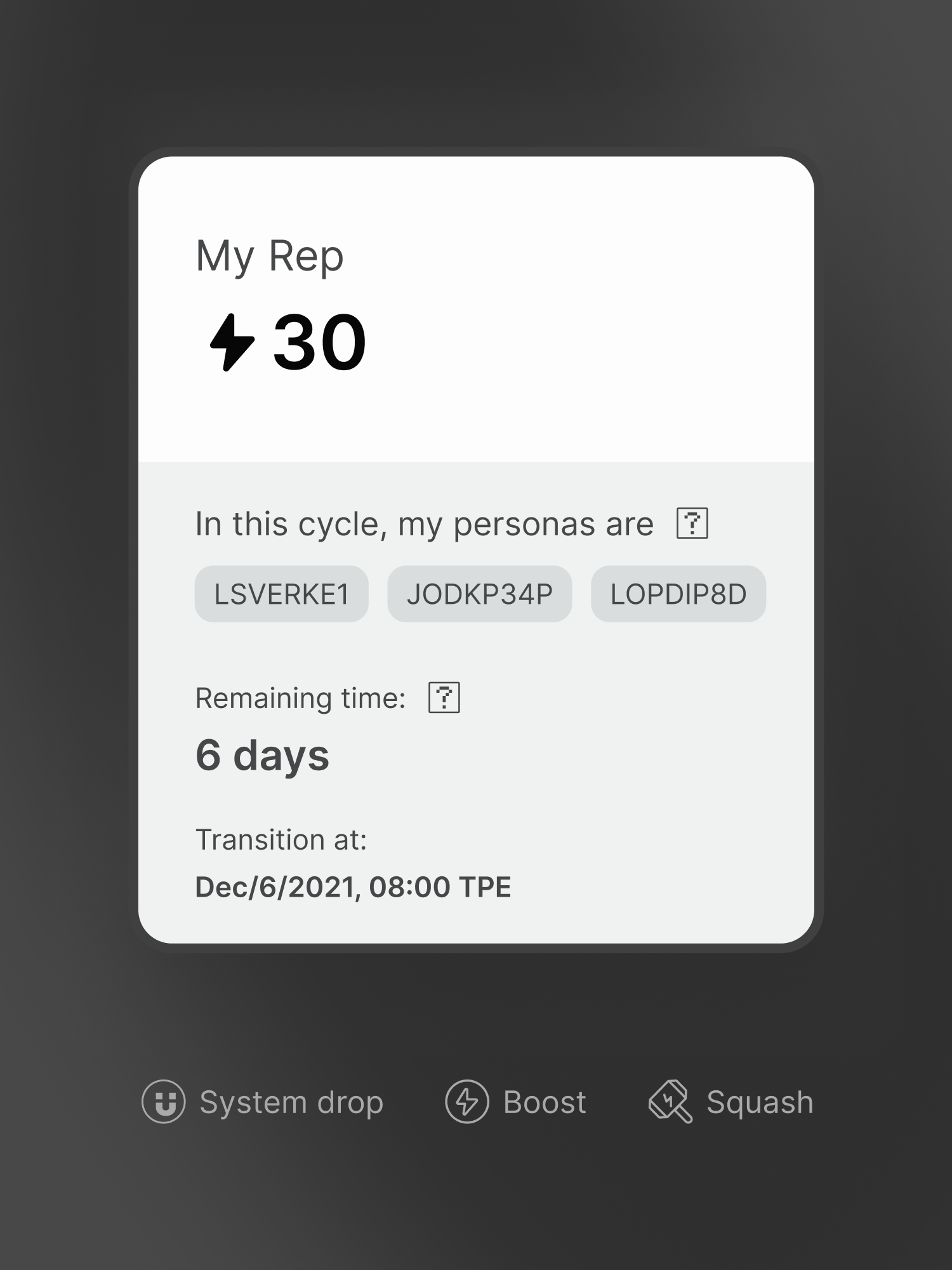
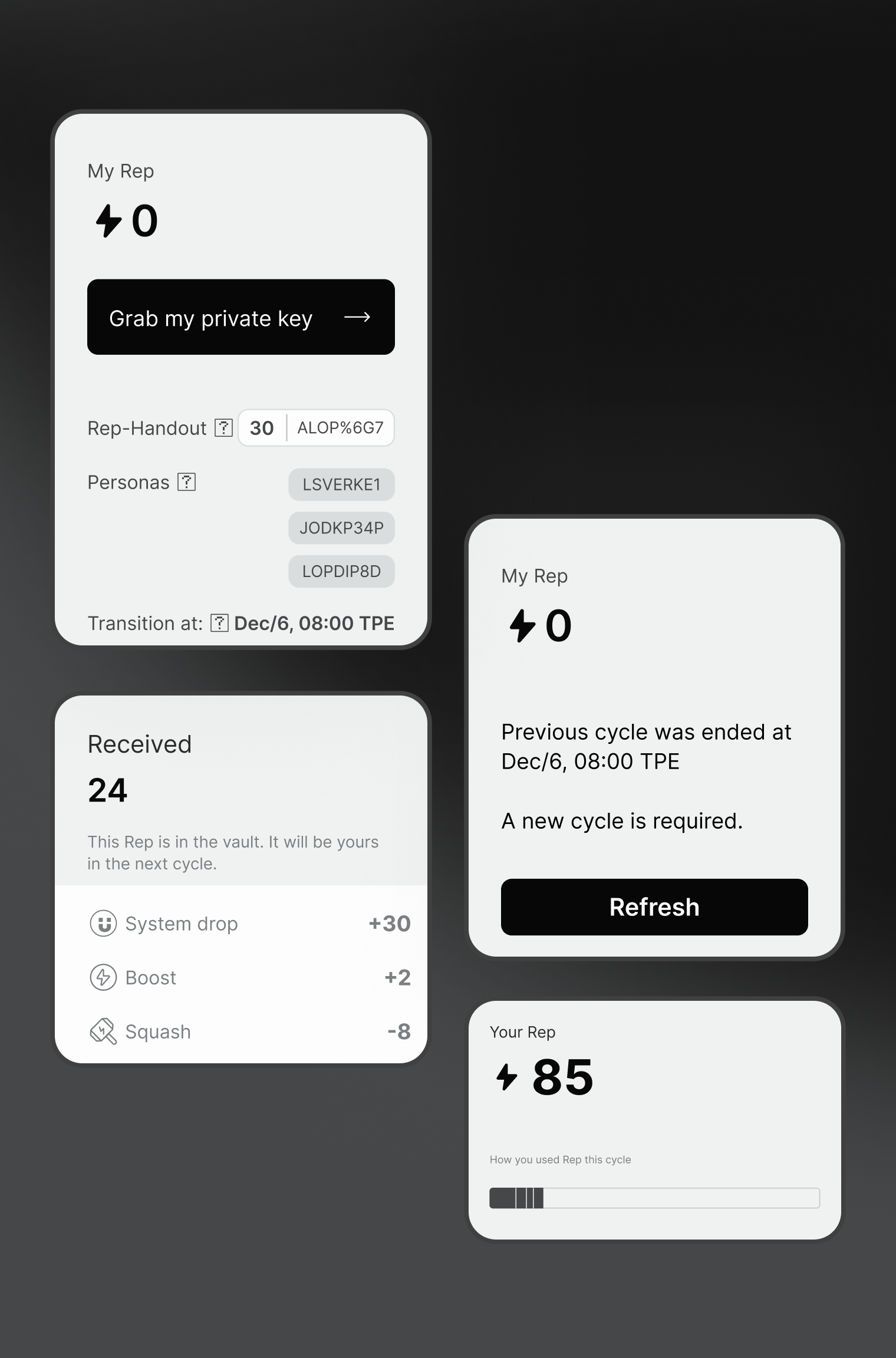
We designed the interaction model so “epoch logic” becomes a simple story for users: You have personas. This persona is active right now. In the next cycle, you’ll get new personas. Your reputation can persist (provably), but your posting identity rotates. This framing helped users understand the core mechanic without needing to grasp the cryptographic details.
To support this, we used practical UI patterns like a clear “active persona” indicator that avoided exposing technical terms by default, and lightweight “cycle change” messaging during epoch transitions that explained what changes and what stays the same.
Reputation + subsidy
Designing for participation without punishing newcomers
A challenge in anonymous reputation systems is bootstrapping: if users must spend reputation to interact, newcomers can feel locked out.
UniRep Social experimented with a per-epoch subsidy: a small allowance granted each epoch for interactions. It resets and cannot be accumulated, which encourages participation while limiting hoarding.
The UX implications we designed around included explaining the difference between “free allowance vs earned rep” without turning the UI into a finance dashboard, making spending feel intentional so users understand tradeoffs, and showing per-epoch limits clearly because the subsidy resets.
The Product market fit challenge
UniRep Social represents an early exploration of anonymous social networking using zero-knowledge proofs, and it taught us valuable lessons about balancing technical innovation with user needs. While we’re proud of what we built alongside other privacy-first social networks, we discovered that protocol complexity needs to be carefully matched with real-world social dynamics.
The experience gave us important insights about building for this space. We’re excited to see how these learnings can inform the next generation of social platforms that genuinely protect user privacy and create safer online communities.